



Chinese companies expanding overseas are entering a new phase—one defined not only by international sales, but by global supply chains, production capacity, and increasingly integrated business ecosystems. As Mr. Yin Tongyue, Chairman of Chery Automobile, has noted, the first stage of going global was taking products overseas; the second was taking production capacity overseas; and the third stage—the stage companies are entering today—is taking entire ecosystems global. Yet HR strategy has not evolved at the same pace over the past decade. For many leading Chinese companies expanding overseas, business growth has increasingly outpaced the development of their HR management capabilities. HR teams are often forced into a reactive mode, solving urgent problems market by market. Some companies turn to workforce outsourcing in an attempt to transfer operational risks to external providers. M&A can introduce fragmented systems, while a growing number of local vendors can make it even harder for headquarters to maintain effective oversight. Even when local HR operations are in place, group-level visibility and governance may remain fragmented and inefficient. Meanwhile, more Chinese companies are establishing local entities, building overseas teams, and investing in R&D and manufacturing capabilities abroad. Global expansion is moving beyond simply "going out" toward establishing a deeper and more integrated presence in local markets—and ultimately building globally connected organizations. Yet among China's top 100 companies expanding overseas, fewer than 15% have what should be considered basic infrastructure for global HR management: a global HCM system. This gap matters. Even in the age of AI, technology cannot change one fundamental principle of business management: data is the foundation of effective strategy and governance. AI can dramatically improve how data is collected, processed, and analyzed, but the value of any intelligent system ultimately depends on the accuracy, integrity, and timeliness of its underlying data.
A finding from the 2025–2026 Survey on Chinese Companies Going Global is particularly telling. Among 175 surveyed companies, compliance and risk were identified as the most challenging capability areas, followed closely by organization and talent. Both ranked significantly higher in concern than finance, strategy, operations, and other areas. This points to a broader shift: as overseas expansion enters a deeper stage, companies are being tested not only on product competitiveness and market development, but also on whether they have the governance capabilities and talent infrastructure required to sustain global operations.
Why Global Expansion Requires an Integrated HR Management Infrastructure?
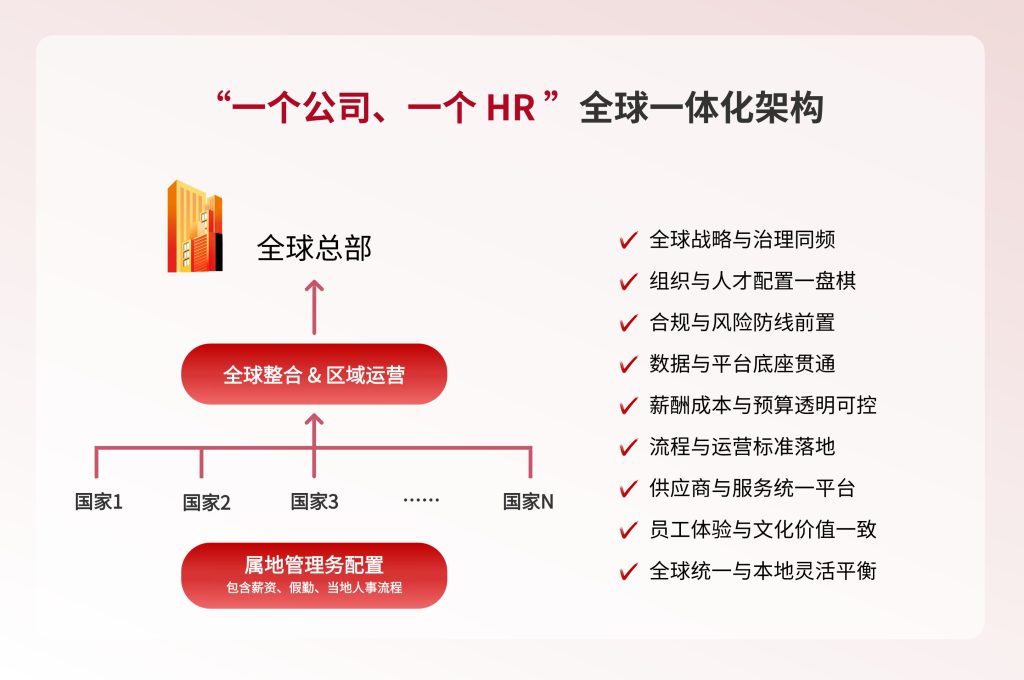
What is the management gap between Chinese companies going global and leading global organizations in Europe and the United States? In the 1990s, leading European and U.S. companies invested heavily in building global resource management and ERP systems, including HR systems. Nearly all aspects of organizational management, operational efficiency, and workforce structure were gradually built around the principle of One company, One HR Strategy. What did this mean? It meant three key things: first, group-level oversight and risk anticipation; second, more efficient decision-making enabled by timely data; and third, the integration of cultural values under One Company, One Brand.
Consider the questions business leaders face when entering a new market: How quickly can we build a team capable of delivering results? How much will our workforce cost? What are the key employment risks in this market? Can organizational capacity keep pace with business expansion? Historically, companies could address these questions through local teams, external providers, and market-by-market coordination. But as operations expand across multiple countries, that model becomes increasingly difficult to manage. Employment laws, payroll and tax regulations, social security systems, and workplace practices vary significantly across markets. If headquarters relies primarily on individual countries to manage these matters independently, common standards become difficult to establish and corporate oversight becomes weaker. At the same time, fragmented data, disconnected processes, and delayed risk signals make it increasingly difficult for headquarters to see what is happening across the organization.
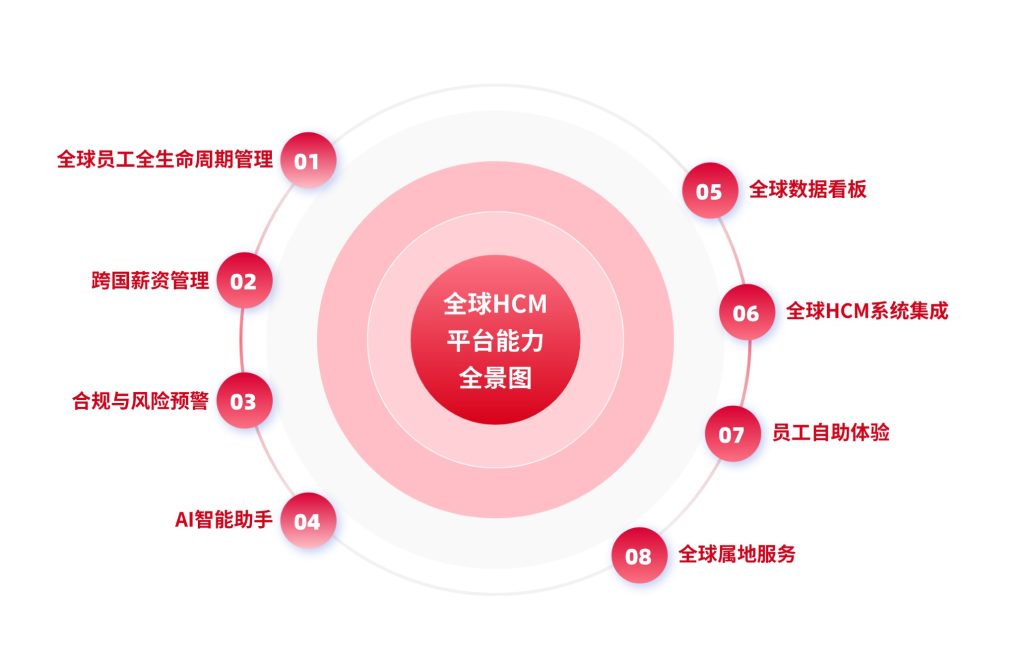
For companies pursuing deeper global expansion, therefore, an integrated global HR management system is no longer simply an HR tool. It is part of the infrastructure for business governance and sustainable growth:
1) A global HR management platform is fundamental infrastructure for risk management. Routine HR activities such as onboarding, offboarding, transfers, and internal job changes require more than standardized processes—they must also be compliant and continuously aligned with changing business needs. Whether these processes are handled manually or digitally, compliance is essential, and process design is critical. This is ultimately about establishing a framework for global authorization and governance: how data is collected and verified, who is authorized to modify it, who can access it, and who has the authority to approve changes to rules. These are all fundamental to ensuring that the organization operates in a sound and orderly manner. An even greater challenge lies in the structure and design of global compensation systems: whether they are competitive, and why they are designed the way they are. These are questions that CEOs often have little visibility into. The reality is that the vast majority of companies expanding overseas do not yet have these capabilities.
2) A global HR management platform is essential for agile decision-making and efficient execution. When companies cannot obtain real-time visibility into the relationship between labor costs and productivity across different markets, cannot see who is working overtime and why, cannot accurately forecast workforce requirements, or understand the underlying causes of employee turnover, CEOs cannot precisely assess whether organizational budgets across countries and regions are appropriate.
3) Ultimately, a global HR management platform should be designed as an employee-centric platform that connects the entire employee lifecycle and focuses on the employee experience. The idea of One Company, One HR is to ensure that every employee, regardless of where they are located, can access their information, performance, incentives and recognition, and benefits and protections through a single platform.
There are also several common misconceptions in decision-making. For example, some companies believe that having an HR system in China means it can be easily upgraded into a global management platform, while others choose to develop payroll systems for each country themselves. Both approaches have proven unworkable and cannot ensure compliance.
Neither AI nor software systems alone can respond with agility to rapidly changing business needs and laws and regulations. For enterprise customers, service is therefore the most important factor. Only by seamlessly integrating a global HR management platform with professional services can companies achieve rapid and scalable expansion. One final point for companies: compliance is not simply a matter of having a few experts interpret regulations, nor is it about having AI collect and interpret the rules of a few countries. Compliance requires continuous improvement across process design, data security, cross-border governance, and technology platform implementation.
Agility: Service Is at the Core of a Fast and Flexible Global HR Management System
In global competition, expanding into overseas markets often comes with significant uncertainty and demanding timelines. Whether building a team quickly in a new market or dynamically adjusting the organization across regions, companies need to establish a functioning local HR management system in the shortest possible time. This makes speed and flexibility the core requirements of a global HR management system: it must keep pace with business expansion worldwide while seamlessly connecting with the company's existing management systems and infrastructure, enabling a smooth evolution with a clear view of the whole organization.
This combination of speed and flexibility is reflected in CDP's work with an international medical device company to build its HR management system across the Asia-Pacific region. Powered by CDP's global HR management platform, Global WorkLife, and enabled by flexible configuration and AI capabilities, the company extended a unified, standardized, and convenient HR management system to 10 countries and regions across Asia-Pacific and nearly 1,000 employees within just a few months. More importantly, Global WorkLife seamlessly integrated with the company headquarters' existing Workday system. This enabled the company to meet local HR management needs quickly while maintaining the management framework and data foundation already established by headquarters, without duplicating infrastructure. It ultimately brought global consistency and local operational flexibility together, allowing the company's digital HR capabilities to evolve alongside its global business.
AI-Powered Compliance: A Global HR Management System Must Hold the Line on Compliance
If speed and flexibility determine whether a global HR management system can keep pace with business expansion, compliance determines whether it can support stable operations.
Different countries impose strict and highly varied legal requirements covering employee data privacy, employment contracts, payroll and taxation, and social security. Applying domestic HR practices directly to overseas employment can easily create serious risks. In recent years, Chinese companies have repeatedly faced significant penalties overseas due to unfamiliarity with local regulations. The consequences can include substantial compensation costs and potentially severe damage to brand reputation and local operations.
Faced with a complex regulatory environment, building a systematic compliance defense mechanism is therefore essential. Drawing on more than 20 years of experience serving more than 5,000 global clients, CDP has helped numerous companies build global HR management systems that precisely align with local labor regulations and comply with multiple international and domestic security standards, including GDPR, SOC 1/2/3, ISO 27001/27018, and China's MLPS Level 3. CDP has further embedded these management practices into its digital platform, Global WorkLife. Through its built-in AI compliance alert mechanism, the platform monitors policy developments and regulatory changes across countries in real time, helping companies proactively identify and mitigate risks.
Embedding compliance capabilities into a global HR management system is not only a strong safeguard against risk, but also an important foundation for stable operations and continued development across markets.
Operational Excellence: Global HR Management Must Be Efficient
Speed and flexibility determine the pace of global business expansion, compliance establishes the bottom line for global operational risk, while efficiency determines whether the global HR management system can truly support business operations.
The complexity of global HR management comes from the challenges of working across borders, time zones, and languages, as well as from the reality that overseas HR teams are often lean. With limited resources, continued reliance on email, manual consolidation, and fragmented approvals to manage global teams can lead to delayed information, rising coordination costs, and HR teams becoming consumed by repetitive tasks, leaving less time for higher-value global business and organizational development.
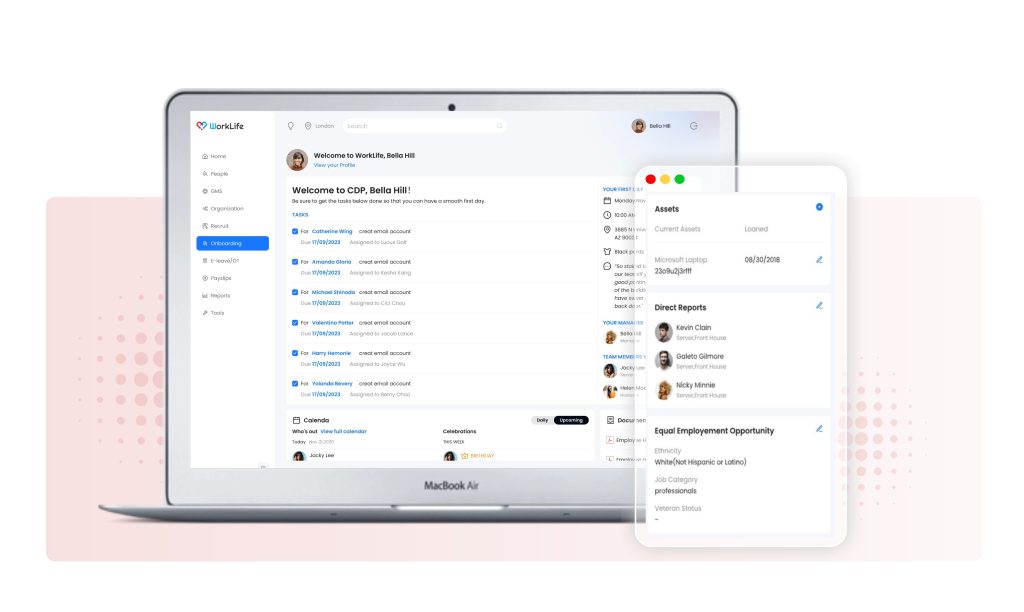
Addressing this requires turning complex cross-border collaboration into standardized, digital HR management processes. CDP has a deep understanding of employee lifecycle management and HR operations, and has embedded these capabilities into Global WorkLife. Through a single platform, it connects global employees, payroll, data, and headquarters management, enabling employees, HR teams, and managers across different locations to work together efficiently. This efficiency is ultimately reflected in measurable operational results: the global employee onboarding process can be completed in 0.5 days; payroll settlement cycles have been reduced from seven days to three while maintaining 100% accuracy; previously fragmented engagements with multiple suppliers have been consolidated onto a single platform; and the system can automatically standardize differences in languages, currencies, and formats and generate employee reports with a single click. Global HR operations and employee experience have therefore been significantly improved.
An efficient global HR management system does not mean investing more resources. Instead, it means using systematic and digital capabilities to enable lean HR teams to coordinate global operations efficiently, supporting a broader global footprint with a lighter organizational structure and making HR a genuine source of support for global business growth.
Conclusion: Building Global Growth on a Strong HR Foundation
When companies go global, what moves overseas is not just the business, but also organizational capability. Faced with the complexity of different markets, a fast, compliant, and efficient digital global HR management system is, at its core, a stable organizational foundation for global expansion, ensuring that wherever the business goes, its organizational capabilities can follow.
When HR can truly support a company's global business footprint, the company can sustain growth across broader markets with a leaner organization and faster response.
[1] Quoted from New Landscape, New Trends, New Challenges: 2025–2026 Survey Report on Chinese Enterprises Going Global, co-authored by CPA Australia, Shanghai National Accounting Institute, and Deloitte China.