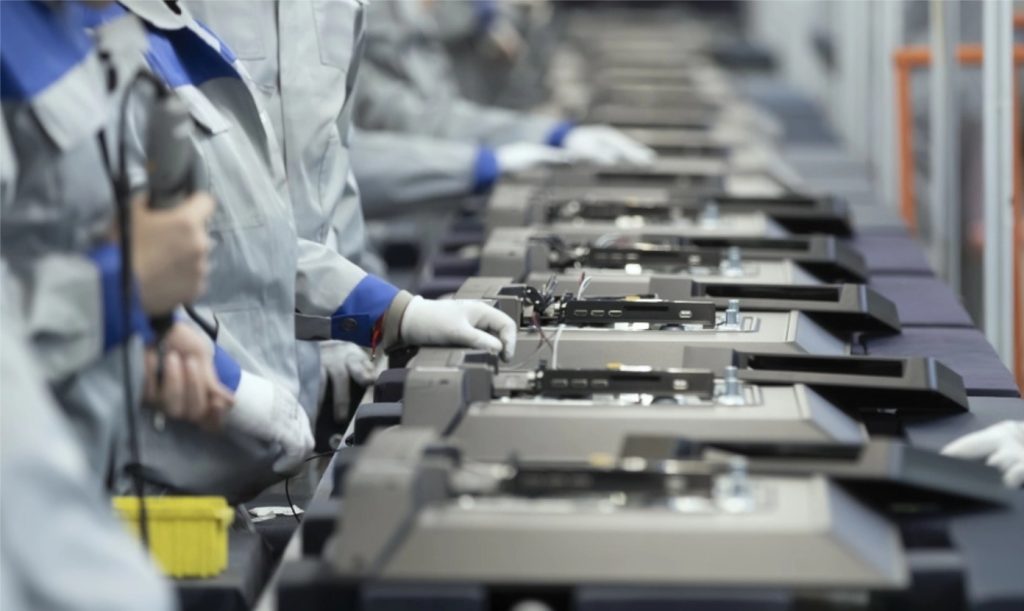





For large manufacturing conglomerates with operations spanning the country and multiple independent legal entities and production bases, the greatest challenge in human resources management lies not in technology, but in how to address extreme complexity and diversity.
A leading global manufacturing giant is a prime example of this challenge. Rules are not independent across multiple factories and legal entities, and data is not shared. Piecework methods, unit price tables, allowances and subsidies, and reward and penalty rules vary from factory to factory. This is particularly true for the piecework wage process—the core of manufacturing operations—which involves thousands of products and dozens of parameters, ranging from production steps and yield rates to scrap rates. The complexity of payroll calculations is extremely high, making manual processing unsustainable and posing significant risks to accuracy and compliance.
The crux of the issue lies in whether a system can be found that respects the unique business characteristics of each legal entity while simultaneously achieving standardized, centralized governance at the group level.
Why has this "one-size-fits-all" approach become a management deadlock?
This client is a global leader in the kitchen and bathroom manufacturing industry, with multiple large-scale production bases in China and its Asia-Pacific headquarters. While the continuous expansion of its business footprint is a positive development, the existing compensation management model has gradually exposed unavoidable shortcomings.
1. Decentralized Payroll Processing and Fragmented Operations
Multiple subsidiaries handle payroll independently, resulting in inconsistent rules and persistently high staffing costs. Piecework methods, unit price tables, allowances, and incentive/penalty rules vary significantly across different production bases. For headquarters to gain a clear overview of the entire operation? It's nearly impossible.
2. The Complexity of Piecework Wages Far Exceeds Expectations
Piecework wages in manufacturing involve over 2,000 influencing parameters, including departments, production processes, target achievement rates, and scrap rates. A change in a single parameter can lead to discrepancies across an entire dataset. Manual calculations are not only extremely labor-intensive but also highly prone to errors—and once an error occurs, it undermines the trust of frontline employees.
3. Without a Unified System, Data Remains in Silos
Data from different regions is scattered and cannot be integrated. Does management want to quickly gain insights into labor costs? It's impossible. When auditors come to check for compliance risks? Those risks have been accumulating all along.
These three issues intertwine to form a deadlock: the more you try to centralize control, the more you discover regional differences; the more you respect those differences, the more headquarters loses control. Where is the solution?
Why Do Traditional Solutions Fail? CDP Takes a Different Approach
Before taking on this project, the client had already tried other solutions. However, traditional solutions typically operate on the logic of applying a single set of standardized rules to all business operations. The result is often a "cultural mismatch"—either the system is too rigid for local teams to use effectively, or it's too flexible for headquarters to manage.
CDP chose a different path: acknowledging and embracing business complexity, using technology to empower—rather than suppress—the differences among business units.
This is the core concept of the "centralized platform + distributed logic" approach—achieving centralized control of data and rules at the group level while preserving flexible configuration space for each legal entity. Simply put: headquarters sets the framework, and local offices fill in the details; standards are unified, but variations are permitted to operate within the framework.
Based on this approach, CDP has built a customized manufacturing compensation platform for clients using WorkLife, with core capabilities including:
- Support for parallel calculation across multiple legal entities and rules, allowing each entity to operate independently on a unified platform;
- Fully automated collection and calculation of piece-rate wages, with seamless integration into payroll systems;
- Flexible configuration capabilities supporting differentiated customization of various pay items, piece-rate templates, and product type logic;
- Integrates bank remittance, individual income tax filing, and electronic pay stubs to achieve end-to-end automation of the "data-calculation-disbursement-archiving" process
This solution was launched in 2011, with the system rollout and process integration for multiple legal entities completed in phases. In 2016, interface optimizations were implemented to further enhance data interoperability and system stability. The partnership continues to this day, with service coverage constantly expanding to new business scenarios.
From Several Days to 5 Minutes: Data Validates the Transformation's Success
Data speaks for itself when it comes to evaluating the effectiveness of a solution. The project's outcomes have been quantitatively validated across multiple dimensions.
Accuracy: Payroll accuracy has reached 100%. The system handles over 200 heterogeneous issues annually and delivers an average of 300 reports per month—meaning it not only calculates accurately but also responds swiftly to anomalies.
Efficiency: Piecework wage calculation efficiency has improved by over 90%. Processing over 6,000 data entries at a time, the time required has been reduced from several days to less than 5 minutes. This represents a qualitative leap—the HR team has been completely freed from tedious calculation tasks.
Coverage: This system serves the client's 18 legal entities across China, spanning over 30 cities, and efficiently supports over 8,000 employees. It supports over 3,000 piecework product types and more than 30 independent calculation logic items, fully accommodating scenarios with multiple rules and processes.
Management value: the system successfully supports multiple paydays and the parallel operation of multiple payroll processes, achieving unified group-wide control. Manual operational costs have significantly decreased, allowing the HR team to focus on higher-value work—strategic support and employee services.
Three Core Insights on Payroll Digitization in Manufacturing
The value of this project lies not only in the client's own benefits but also in the reusable methodology it provides for managing complex payroll in the manufacturing sector.
Insight 1: High customization can address ultra-complex payroll scenarios.
Supporting real-time calculations involving thousands of parameters—a feat nearly impossible in traditional ERP or standard HR systems—has proven achievable. As demonstrated, with proper architectural design, ultra-complex payroll scenarios can be operated seamlessly on a unified platform.
Insight 2: Seamless integration with existing data ecosystems is feasible.
Through multi-type data interfaces, the system adapts to each factory's existing data collection methods, eliminating the need to start from scratch or disrupt current processes.
Insight 3: The system's high scalability determines how far it can go.
This platform not only supports current operations but can also effectively accommodate future corporate mergers, spin-offs, and business diversification—without requiring a complete overhaul due to organizational changes.
The Essence of Over a Decade of Collaboration: Embracing Diversity Through Technology
The client's partnership with CDP has spanned over a decade. Starting with payroll outsourcing and gradually expanding to a full-process HR digital solution, CDP has built an efficient, stable, and scalable payroll calculation platform for the client, with WorkLife at its core.
This collaborative journey illustrates a simple truth: the essence of digital transformation does not lie in using technology to eliminate differences, but in using more advanced platforms and technical architectures to embrace, manage, and empower those differences.
For manufacturing enterprises facing similar challenges of multiple factories, diverse rules, and highly complex payroll calculations, this case study offers a clear path forward: a system capable of supporting both standardized control and differentiated execution may well be the most worthwhile investment.