




At the end of every month, Xiao A, the company's Total Rewards Manager, found her inbox filled with the same questions:
"When will my transport allowance be reimbursed?"
"The process is too complicated—I’m not going to apply anymore."
"Doesn’t the company offer a dinner allowance for late shifts? Why have I never actually received it?"
As an HR professional, Xiao A felt a mix of frustration and reflection. The company invested heavily in employee benefits each year, yet employees rarely perceived their value.
She worked for a fashion retail company with over 1,000 employees, including a headquarters in Shanghai and stores across the country. The company had long offered transport allowances and dinner allowances for lateshift staff, designed to help offset employees' daily expenses while strengthening talent attraction and retention. In reality, however, employee satisfaction with benefits remained lukewarm, and some even complained that “the company offers hardly any benefits”.

When Reimbursements Become a Barrier
So where was the problem? While reviewing the process, Xiao A discovered that both allowances were handled through reimbursement. Employees first had to cover the expense themselves, then submit applications, which went through multiple approval steps—store managers, HR, finance, and more—before reimbursement was finally completed.
For employees, a few hundred yuan in subsidies came with a string of tedious procedures: filling out forms, uploading receipts, waiting for approvals, tracking payment status… Many simply chose not to claim the benefit at all. “For just a few hundred yuan, I have to fill out forms, get approvals, and wait for reimbursement—it’s too much trouble.”
She gradually realised that employee benefits are defined not only by what companies provide, but also by how easily employees can access them, but also about how easily employees can use them. No matter how generous a benefit is, if the barrier to access is too high, it becomes a burden rather than a perk.
No More Reimbursements: Benefits Made Simple
So the company decided to redesign its employee benefits system and introduced the CDP Flexible Benefits Platform.
The first change was the way transport and meal allowances were distributed. Each employee received a digital benefits account and directly credited the allowances into these accounts. Employees no longer needed to pay first and claim back later. They simply opened the benefits mall, used the platform’s integrated services—food delivery, ridehailing, etc.—and the system automatically deducted the equivalent points from their benefits account. The entire experience became seamless, requiring just a few clicks.
The impact was immediate. The time HR and finance spent on allowance reimbursements dropped by 80%, and a large volume of repetitive administrative work was automated. Xiao A and her team were finally able to focus on designing better employee experiences rather than processing repetitive administrative tasks, and improving employee experience. Even more gratifying was the feedback from store managers—they now proactively mentioned the meal and transport allowances during interviews for sales associates, “and the way they’re distributed is so userfriendly; employees don’t have to front the money.” One manager said that this single feature had already helped attract several strong candidates.
A New Challenge Emerged
After the benefits mall went live, the efficiency of distributing transport and meal allowances improved significantly, and employees’ experience in claiming and using them got much better. But after some time, Xiao A noticed a new issue:
While the transport and meal allowances covered most employees’ needs, they weren’t suitable for everyone. For example, some employees rarely order takeout, and those who drive don’t use ridehailing services. If the benefit content was a one-size-fits-all approach, not every employee could equally appreciate its value.
To address this, Xiao A began to think about what benefits different roles, age groups, and life stages actually needed. With the CDP Flexible Benefits Platform, the company expanded beyond transport and meal allowances to a broader “lifestyle services” category covering daily lifestyle services. Employees were no longer limited to a single form of benefit; they could freely choose according to their personal needs. Using the points in their benefits mall account, they could place orders online and have items delivered to their doorstep, or redeem services at designated stores.
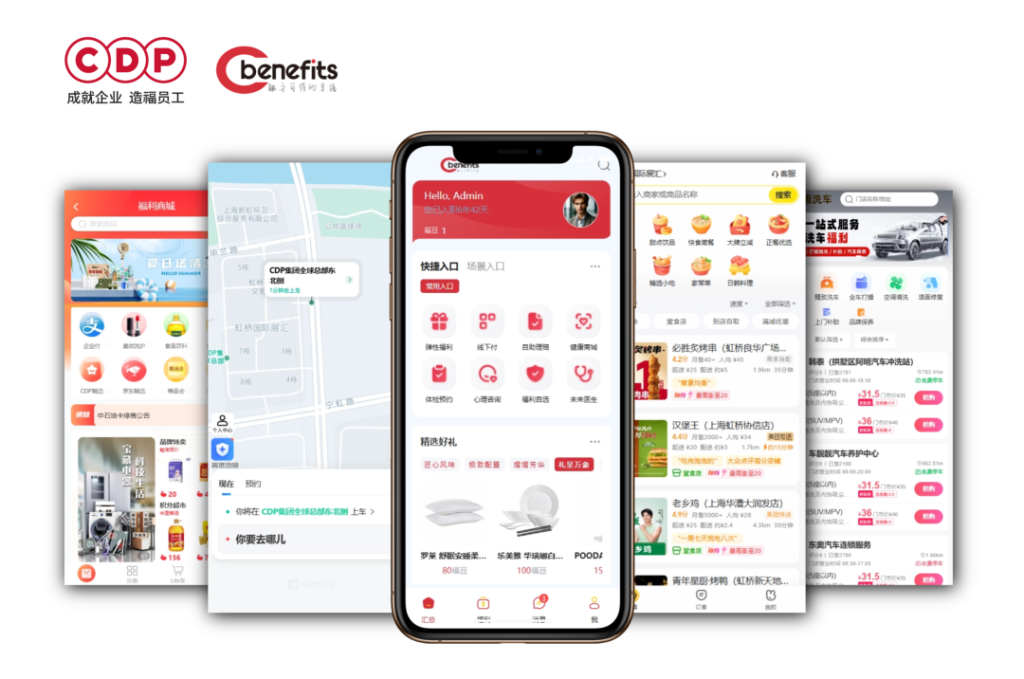
CDP Flexible Benefits Mall encompasses key scenarios including dining ordering, home services, and travel services, and further extends to food delivery, movie ticketing, automobile services, mobile recharge, gift cards and vouchers, health examinations, etc. Accessible via both PC and mobile, it enables employees to make instant purchases using their benefit points.
Employees could now choose from a lot of benefits options: some used their points for laundry services, others for an annual family carwash card, and some for popular movie tickets. The same benefit budget, because it matched different employees’ lifestyles, created greater perceived value for different employees — and made the company’s benefits work much harder.
Benefits Management Is Becoming a Strategic Talent Advantage
After implementing the digital benefits system, the company conducted an internal survey. The data showed that employee satisfaction with benefits jumped by 26 percentage points, and the benefit utilisation increased from below 40% to 92%. Meanwhile, HR Business Partners reported that when they introduced the benefits package during recruitment, offer acceptance rates also improved.
These changes demonstrate that employee benefits are no longer just about distributing perks or subsidies—they have become an important part of the employee experience and employer value proposition.They help solve employees’ daily concerns about meals and commuting, make them feel that the company cares about and responds to their needs, and give the company a clear advantage in attracting and retaining talent.
For any organisation, to derive strategic value from benefits, it’s not enough to decide what to offer—you also have to consider how to deliver them. With a digital benefits mall, companies can precisely align benefits with employee needs, boosting both employee experience and HR operational efficiency. When benefits are managed strategically through a digital platform, organisations can deliver a better employee experience, improve HR efficiency, strengthen their employer brand, and maximise the long-term value of every benefits investment.